Choosing an Aqueous Pigment Dispersion for Ricoh Gen5 and Gen6 Printheads
A black ink that runs well on a Ricoh MH5420 still needs a drop test on an MH5320. Ricoh publishes the same viscosity and surface tension ranges for both, but the binary drop changes from 7 to 5 pL. Start with the full head code and intended print mode. Select the pigment concentrate for colour and stability, then qualify the finished ink at the temperature and waveform used by the printer.
Which Ricoh head is installed?
Ricoh identifies its MH5420/5421 series as fifth generation and its MH5320/5340 family as sixth generation. The suffix matters even within a family. For example, MH5421 and MH5421MF have different published viscosity figures. Ask for the complete code on the head or service record before specifying an ink. Ricoh on its fifth generation · Ricoh on its sixth generation.
| Model and source | Ink viscosity | Surface tension | Detail for the trial |
|---|---|---|---|
| MH5420 / MH5440 | 10–12 mPa·s | 28–35 mN/m | 7 pL binary drop. The two models support up to two and four colours respectively. |
| MH5421 / MH5441 | 11 mPa·s | Unspecified on this product page | Dedicated aqueous heads. The published drop volumes are 7, 14 and 21 pL, depending on the ink. |
| MH5421F / MH5421MF | F: 11 mPa·s MF: 6 mPa·s | Unspecified on this product page | Both have internal ink recirculation. Identify the exact suffix and record the supply and return conditions. |
| MH5320 / MH5340 | 10–12 mPa·s | 28–35 mN/m | 5 pL binary drop and 5–15 pL greyscale. Check each production drop level with the intended ink. |
These models have an integrated heater and thermistor. The head’s operating temperature limit and the temperature at which ink viscosity was measured are separate entries in a trial record. The linked pages do not give the viscosity measurement temperature or, where surface tension is quoted, its measurement method. Obtain the installation’s operating setpoint from the printer supplier, measure the finished ink there and report the method. A temperature reading at the reservoir can differ from the fluid temperature at the head.
What can the black dispersion data tell you?
Consider a formulator developing an aqueous carbon-black ink. AIC-Black 0058 is a carboxylic PBk7 concentrate with nominal 15 wt% pigment. Its TDS lists viscosity up to 3 mPa·s and surface tension of 40–80 mN/m. These are concentrate properties. In an illustrative 500 g ink trial targeting 3 wt% pigment, 100 g of this concentrate supplies the 15 g of pigment, assuming its nominal loading. The other 400 g of vehicle and additives materially affect the final ink. Black 0058 TDS (PDF).
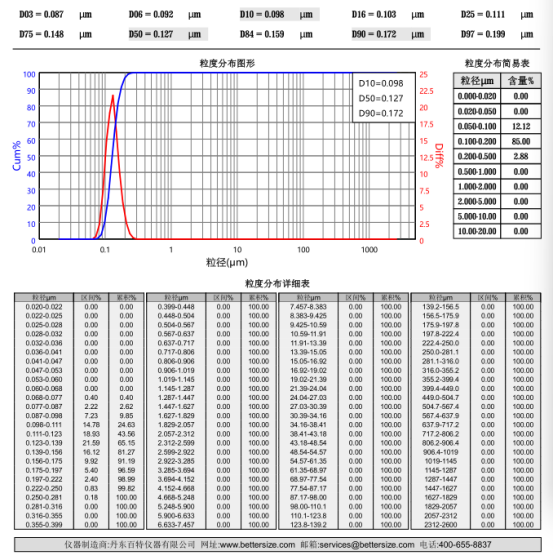
The published Black 0058 sample measured 127 nm at D50 and 172 nm at D90. Use these figures to compare incoming lots measured on the same basis. An aged blend also needs a filtration test. With the same membrane, area and pressure used for the reference ink, record the volume passed over time. A loss of throughput after adding a binder can show instability that the original concentrate report could never reveal. Original Black 0058 particle-size report.
How should the press trial distinguish an ink issue from a head setting?
- Establish the reference. Run the printer’s qualified reference ink with the integrator’s specified waveform, meniscus pressure and temperature. Save the nozzle check and the drop images for each grey level used by the job. For a change of head family, establish this baseline separately on each head.
- Check delivery under load. Run the candidate through the correct filter and degassing system. Compare a low-coverage pattern with sustained solid fills. If missing nozzles appear primarily during solid fills, record the filter pressure drop, ink supply pressure and local temperature before changing the formulation. On a recirculating head, also log return pressure or flow according to the printer’s setup.
- Watch the smallest working drop. At the approved drive settings, measure velocity and direction and inspect for satellites. Record the firing frequency and repeat at the larger drop levels used in production. For the MH5320, Ricoh gives different frequency figures for three- and four-level operation. Match the actual mode when scheduling a sustained run. MH5320 mode specifications.
- Measure restart cost. Reproduce an ordinary production pause with the same capping and idle-circulation state. Count missing or deflected nozzles before the pause and at first restart. Record how many normal cleaning cycles are needed to recover the reference nozzle pattern. Agree the acceptable downtime and ink loss with the printer operator before testing.
Ricoh lists tested finished water-based pigment inks for specific MH5320 applications, including textiles and books. That list is useful when defining a comparable reference run. An AIC sample supplies the colourant for your own recipe, whose vehicle, print mode and recovery performance require qualification on the installed machine. Ricoh’s tested-ink list.
For a Black 0058 sample, include the MH code, target pigment loading, normal operating temperature and typical pause length. That information gives the lab a starting point for preparing comparison inks. Request a Black 0058 sample · Compare AIC concentrate data.