How to Select an Inkjet Pigment Dispersion Using D50, D95 and Printhead Data
A customer specifies a maximum D95. The cyan supplier sends a report with D50, D90 and D97. Can you release the sample for a print trial? A real report from AIC-Cyan 6900 shows what you can establish from the size distribution, what to ask the laboratory for and which properties to check on the finished ink.
What can you establish when D95 is missing?
D50 marks the midpoint of a cumulative size distribution. D95 marks the diameter at which it reaches 95%. The weighting matters. On a volume basis, the remaining 5% is a share of particle volume. Counting particles would give a different distribution. Ask the supplier to name the basis and measurement method used on the report. Malvern Panalytical’s guide to size distributions.
AIC-Cyan 6900 is an aqueous PB15:3 concentrate with 15 wt% pigment. Its published sample report gives D50 of 141 nm, D90 of 197 nm and D97 of 228 nm. The detailed table reaches roughly 90% cumulative at 0.197 µm and nearly 96% at 0.222 µm. That places D95 in the 197–222 nm interval for this sample. The instrument report does not print a separate D95 result. Inspect the original Cyan 6900 chart and size bins.
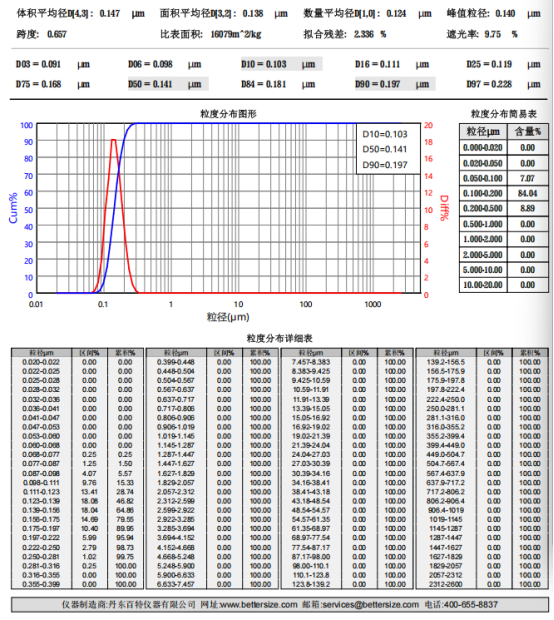
Suppose a purchaser proposes D95 ≤ 210 nm as a trial criterion. This is an illustrative limit. The interval spans 210 nm, so the summary cannot settle that decision. Ask for the instrument’s D95 export for the sampled lot, with the same preparation and calculation settings. A straight-line estimate between D90 and D97 assumes a curve shape the summary does not establish.
Why can a fine dispersion still give nozzle trouble?
The median can stay nearly constant while a small fraction of particles forms larger clusters after the concentrate meets the binder, salts or other additives. D95 is more sensitive to this change, yet an infrequent contaminant may still have little effect on either percentile. Repeat the measurements after mixing and storage, and check filter throughput against a reference ink under the same conditions.
The fluid path can also matter. In a piezoelectric printhead study using model polystyrene particles, Li and colleagues observed recurring air blockages after certain particles deposited on internal surfaces. A purge cleared the air, but the retained deposits allowed the problem to recur. If a nozzle returns after cleaning and drops out again, record the restart pattern and check air handling and surface deposits alongside the size report. Li et al., Langmuir (2019).
Which printhead limits apply to the finished ink?
The viscosity values below describe fluids for three named heads. A concentrate will usually change viscosity and surface tension when blended with water, humectants, binder and wetting agents. Measure the complete formulation at the temperature agreed for the installation. Keep the exact head suffix on the trial record.
| Printhead | Published ink property | How to apply it in a trial |
|---|---|---|
| Epson I3200(8)-A1HD | Aqueous ink. Reference viscosity of 2.2–3.8 mPa·s. | Epson lists no internal heater. The sheet labels the range a reference value and gives no measurement temperature. Check the ink temperature actually maintained by the printer. Epson I3200(8) data sheet (PDF). |
| Ricoh MH5420 | Aqueous ink is among the supported types. Viscosity 10–12 mPa·s and surface tension 28–35 mN/m. | The head has an integrated heater. Ricoh lists an upper operating temperature of 60 °C separately. Confirm the intended ink setpoint and the surface-tension measurement conditions before comparing results. Ricoh MH5420 specifications. |
| Kyocera KJ4B-YH06WST-STDV | Aqueous ink. Typical viscosity 5.0–6.0 mPa·s. | Kyocera specifies this range at the printhead operating temperature. Measure at the chosen setpoint and confirm the requirements for the installed head revision. Kyocera KJ4 specifications, printed page 5 (PDF). |
These sheets give no incoming pigment D95 acceptance limit for the three heads. For drop testing, agree the waveform, firing frequency and ink temperature with the integrator. At a fixed waveform, changes in viscosity affect refill and pressure-pulse damping. Record drop velocity, direction and satellite droplets alongside nozzle recovery after an idle period.
For the next trial, open the model-specific guide for Epson I3200 and S3200, Ricoh Gen5 and Gen6 or Kyocera KJ4B.
What belongs in the acceptance specification?
- Incoming concentrate. Identify the pigment, grade and lot. Specify the size method, weighting, dilution liquid, mixing or sonication and replicate sampling. Compare D50 and D95 with a qualified reference lot using the same method. Use method repeatability and production history to set tolerances. ISO 13320:2020 for laser diffraction measurements.
- Finished ink before and after storage. Record pigment loading, storage time and temperature. Repeat the size test and measure viscosity at jetting temperature. For filtration, use the same filter medium, rating and area as the reference trial. At constant flow, compare the pressure rise over a specified volume of ink.
- Performance at the head. Agree the run length and idle time before testing. Count missing or deflected nozzles after continuous firing, then again after the specified restart procedure. Set allowable nozzle losses and cleaning cycles from the printer’s production target and results with the approved reference ink.
A D95 can support lot release once its measurement and limit are agreed. Initial printhead qualification needs the outcomes of all three steps. For a PB15:3 trial, the product page brings together the technical sheet, original report and sample request. Review AIC-Cyan 6900.